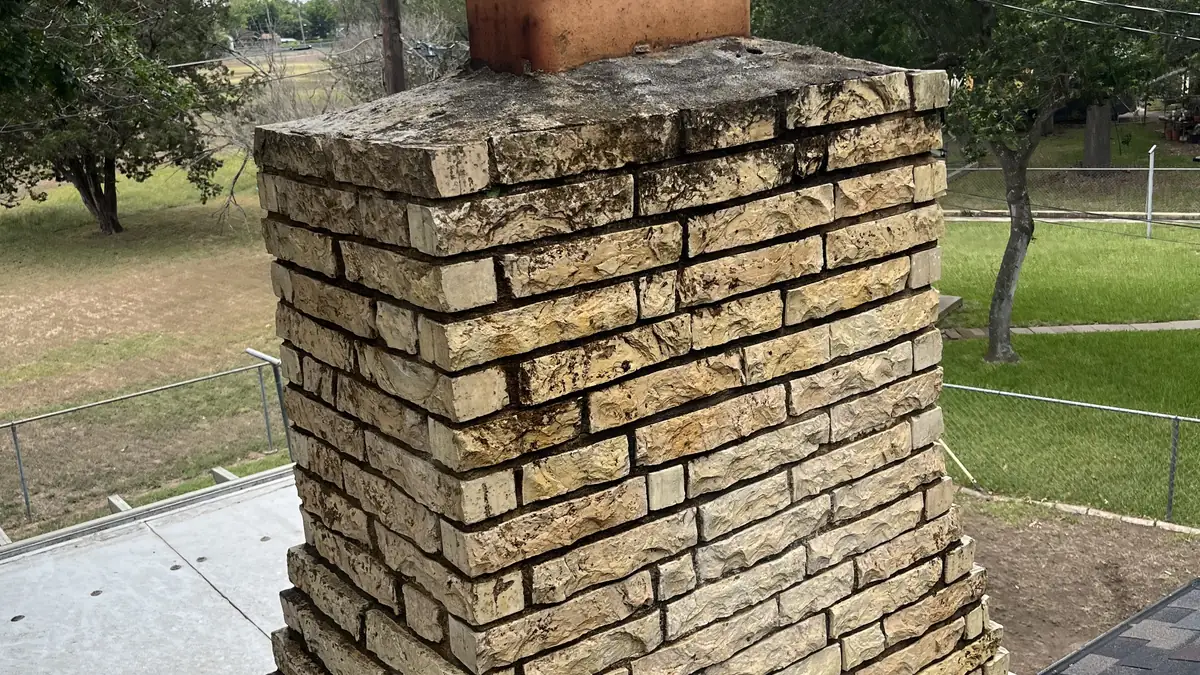
Why Is My Chimney Leaking When It Rains?
A chimney that leaks when it rains almost always points to one of four things: failed flashing where the chimney meets the roof, a cracked crown (the concrete cap on top), a missing or damaged chimney cap, or porous brick and mortar that’s soaking up water. San Antonio’s pattern of long dry stretches followed by heavy downpours is hard on masonry — materials expand and contract, and small cracks that seem harmless in July can let water pour in during a September storm.
Here’s how to narrow it down:
- Water stains on the ceiling or wall near where the chimney meets the roofline? That’s a strong sign of flashing failure. Flashing is the metal strip sealing the joint between the chimney and the roof, and it’s one of the most common leak points on any chimney.
- Water shows up inside the firebox or on the smoke chamber walls? Look up. A cracked crown or a missing cap lets rain fall straight down the flue.
- Damp brick, stains, or a chimney that seems to hold moisture long after rain stops? The masonry itself may be porous and absorbing water directly through the brick and mortar joints.
Ignoring any of these lets water keep working its way into the structure with every rain. A (210) 418-9810 call or book online visit gets a tech up on the roof to actually find the source rather than guess — our chimney inspection is $144 flat and includes a full visual inspection of the flashing, crown, cap, and brick.
How Much Does Chimney Flashing Repair or Replacement Cost?
Flashing repair cost depends on how much of it needs to be redone and whether it’s a patch/reseal or a full tear-out and reinstall. A small section that’s lifted or separated from age can often be resealed or partially replaced. A full flashing replacement — pulling old metal and starting over with a proper step-and-counter-flashing installation — is a bigger job because it involves working with the roofing material around the chimney, not just the chimney itself. Get an on-site look before assuming which one you need, since flashing damage is often worse (or better) than it looks from the ground. Call (210) 418-9810 or book online for an inspection and a firm number.
Chimney Crown Repair vs. Full Rebuild: Which Do I Need?
Crown repair fixes surface cracks or minor deterioration in the concrete cap on top of the chimney without touching the structure underneath — this is the right call when the crown itself is cracked but the masonry below it is sound. A full rebuild goes further, addressing damage that’s spread into the brick and mortar of the chimney stack itself, which usually happens when a cracked crown has been leaking for a long time and water has undermined the structure below.
The way to tell which you need is an inspection: a tech looks at the crown for hairline cracks versus larger separation, then checks the brick and mortar joints just below it for spalling, crumbling, or gaps. Crown damage caught early is a much smaller job than a rebuild, which is the main reason to get a leak checked out as soon as you notice it rather than waiting.
Do I Need a Chimney Cap, and What Does One Cost to Install?
Yes — a chimney cap is one of the simplest ways to stop rain, debris, and animals from getting into an open flue, and if yours is missing or damaged, rain has a direct path straight down the chimney every time it storms. A cap sits over the top of the flue and keeps water out while still letting smoke and gases vent properly.
Cap installation cost depends on the flue size and cap style needed. Since a missing or damaged cap is one of the four most common causes of a rain-triggered leak, it’s often the fastest, most affordable fix once an inspection confirms it’s the source. Ask for pricing specific to your chimney at (210) 418-9810 or book online.
What Are Those White Chalky Stains on My Brick Chimney?
Those white, powdery stains are called efflorescence — a mineral deposit left behind as water moves through masonry and evaporates on the surface, carrying dissolved salts from inside the brick and mortar with it. Efflorescence itself isn’t damage, but it’s a visible signal that water is actively getting into your masonry, which is worth paying attention to.
Since San Antonio’s clay soil and swings between drought and heavy rain put extra stress on brick and mortar, seeing efflorescence is a good reason to have the chimney checked for the underlying moisture source — porous masonry, a crown crack, or flashing — rather than just cleaning off the stain and moving on.
Why Does My Chimney or Fireplace Smell Like Smoke in the Summer?
A smoky smell from the fireplace in summer is usually creosote — the residue left behind from burning wood — off-gassing as it sits in the flue. Heat and humidity make it worse, since warm, moist air pulls those odors down into the house instead of venting them out. A poor draft or a damper left open can also let more of that smell drift into the living space.
If the smell is strong or new, it’s worth having the flue checked and swept — creosote buildup is also a fire-safety issue, not just an odor one. A $144 sweep and inspection clears it out and confirms there’s nothing else going on. Reach us at (210) 418-9810 or book online.
Ready to find (and fix) your leak? Sweeppy’s $144 chimney inspection covers the flashing, crown, cap, and masonry so you get a straight answer instead of a guess. Call (210) 418-9810 or book online to get on the schedule.